

Digital Spirituality

The Role of the Unseen
It is becoming increasingly obvious to me that the role of the unseen in our lives is undeniable and essential. These “things” that are nonmaterial – things like God, love, courage, morality, truth, justice, joy, fulfillment – define the value and meaning of a human life.

In a materialist and materialistic culture, these things are taken for granted or diminished through labeling them as subjective, and therefore not real in any enduring sense. There is also a dark side to the nonmaterial. Evil, despair, hatred, and apathy are the most destructive forces on the planet. We can’t see and touch them, but we know their effects deeply.
Within the grand scheme of human history, I come from a WEIRD1 culture. It is “weird” because it unusual – only existing within the span of around the last 100 years in a small subset of the population – and because it denies the reality of the nonmaterial in our lives… A very peculiar and inhuman way to live if you compare it to the vast expanse of traditional and indigenous cultures throughout history.
Scientific and technological advancement remade the world. Up until fairly recently, the changes they wrought were largely material, affecting and existing only in the material world. These changes also remade our image of the material world through a rationalist, formulaic, and materialist lens. These are not nonobjective goggles, but they are incredibly powerful at dismissing what doesn’t fit within those parameters.
Digital Atheism
The digital age gained footing in American society in the 80s with the advent of personal computers, early Internet computing, and digital music. Interestingly enough, this is when movements towards atheism/non-religiousity began their steady increase in the United States, hitting their largest spikes in the 2010s (when everybody started using smartphones and had the digital with them 24/7).2
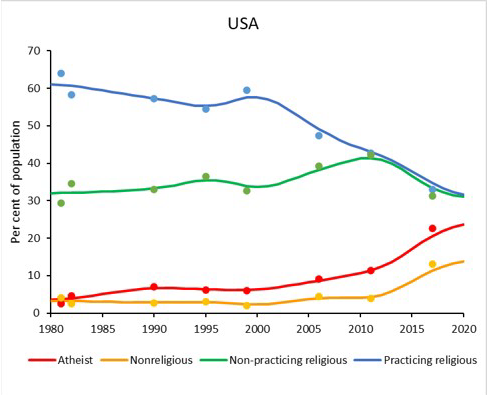
The role of the nonmaterial in our lives hasn’t changed. We have just migrated our need for the nonmaterial onto digital technology. How often have you heard someone refer to a website as a location, or a blog as a “corner of the internet?” These metaphors reveal an increasing belief in the placehood of the internet, and namely the digital “world.” Where does the internet exist though? No-one could tell you. It’s this vast, nonmaterial space that humans constantly interact with, and whose events affect the material world in drastic ways. Sure, there are wires, cables, signals, things of that nature that allow us to connect to the internet, but none of them are where the internet exists. It’s both nowhere and everywhere.
Similarly, nobody can tell you where dreams are, where the afterlife is, where the spiritual world is (if one admits it even exists). We are all aware of the non-place of nonmaterial realities. The internet is just the latest and most prolific version of it... one whose existence can be tidily explained through materialist and rationalist goggles. But did the internet exist in some way before we harnessed the technology to access it, or is it a nonmaterial illusion? Is it as real as dreams, prayer, and visions?3
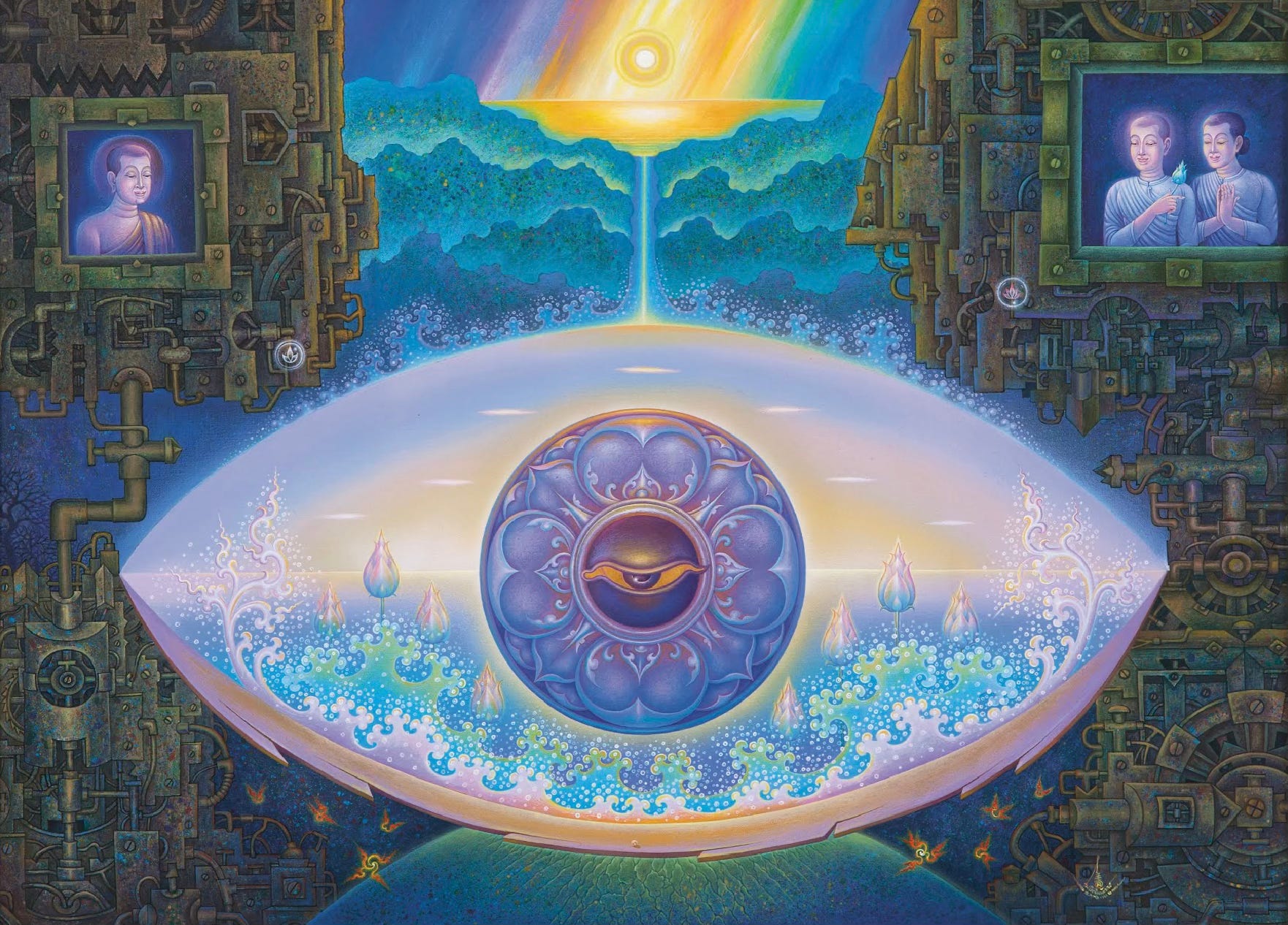
A few years ago, I started a personal tradition where I fast from all digital technology and screens every year between Christmas and New Years. I usually don’t need to contact anybody during that time, and nobody tends to be working so it’s easy to get away with it. The first day or two are always a bit tedious, but being with family helps. Pretty soon, I fall into a rhythm of reading, writing by hand, staring out in space, talking, and just existing. I don’t miss the internet at all, and I always feel so good. I am always surprised by this. If I glimpse a screen during the week, someone next to me on their phone, I feel ill and overstimulated. As the end of the week nears, I start to dread going back to email and screens. Existing in my body with the world, like how humans have lived for 99.9999999% of our existence, is much more preferable. Yet, every year on January 1st or 2nd, I return, and I get sucked right back into the rhythm of it. But I always look forward to that part of the year, it’s a good reminder of the illusory and ephemeral nature of the digital “world.” Still, I constantly have to make peace with the existence of digital technology. It’s where I do most of my work, and life without it would mean giving up on countless opportunities and interactions with society and culture. If I could travel back to a world without it though, I would.
The reason I bring up these two things together – the nonmaterial in relation to the digital and the spiritual – is that they exist in competition with one another. For every craving we experience, there exists a fulfillment of that hunger. We are material creatures – needing food, sex, water – relational creatures – needing companionship and touch – spiritual creatures – needing a connection to what is above and beyond our materiality.
These needs can and should be fulfilled, but with discernment. Sexual desire marks the impulse to create new life, consummate romantic love, and is what precedes our own emergence into this world. However, when sexual desire is excessively channeled through pornography, it is vastly destructive to health and relationships. Similarly, if I was to regularly consume fast food and soda to satisfy my hunger and thirst, I would quickly destroy my body. These things may satisfy my momentary appetites, but I would starve myself of essential nutrition.
Is it possible that the rise in digital use starves us of the relationship with the spiritual?
When religion is eviscerated, something else always rushes in to fill the place of worship and sense-making. For the past ten years or so, that thing has been politics for many people, which has increasingly encroached on all spheres of life. In the future, it may be technology.
If and when AI becomes so powerful and pervasive that it becomes confused with something enduring and intrinsic to reality (as many now view the internet), it is primed to rush in and fill that “God-shaped hole.” Yet, unlike God, AI didn’t create the world, we created AI. And unlike God, AI will happily answer you at your beck and call, giving you and telling you exactly what you want. It won’t challenge you, it won’t love you, it won’t fulfill you, because it will be you. A distorted, amplified, and all-powerful you, divorced of any humility or limits. Yet, like God, AI will inhabit the “spirit” of physical “beings4,” animating their movement. This won’t be a real spirit, a real soul, or real consciousness, but people are quickly conditioned to accept the artificial for the real thing.
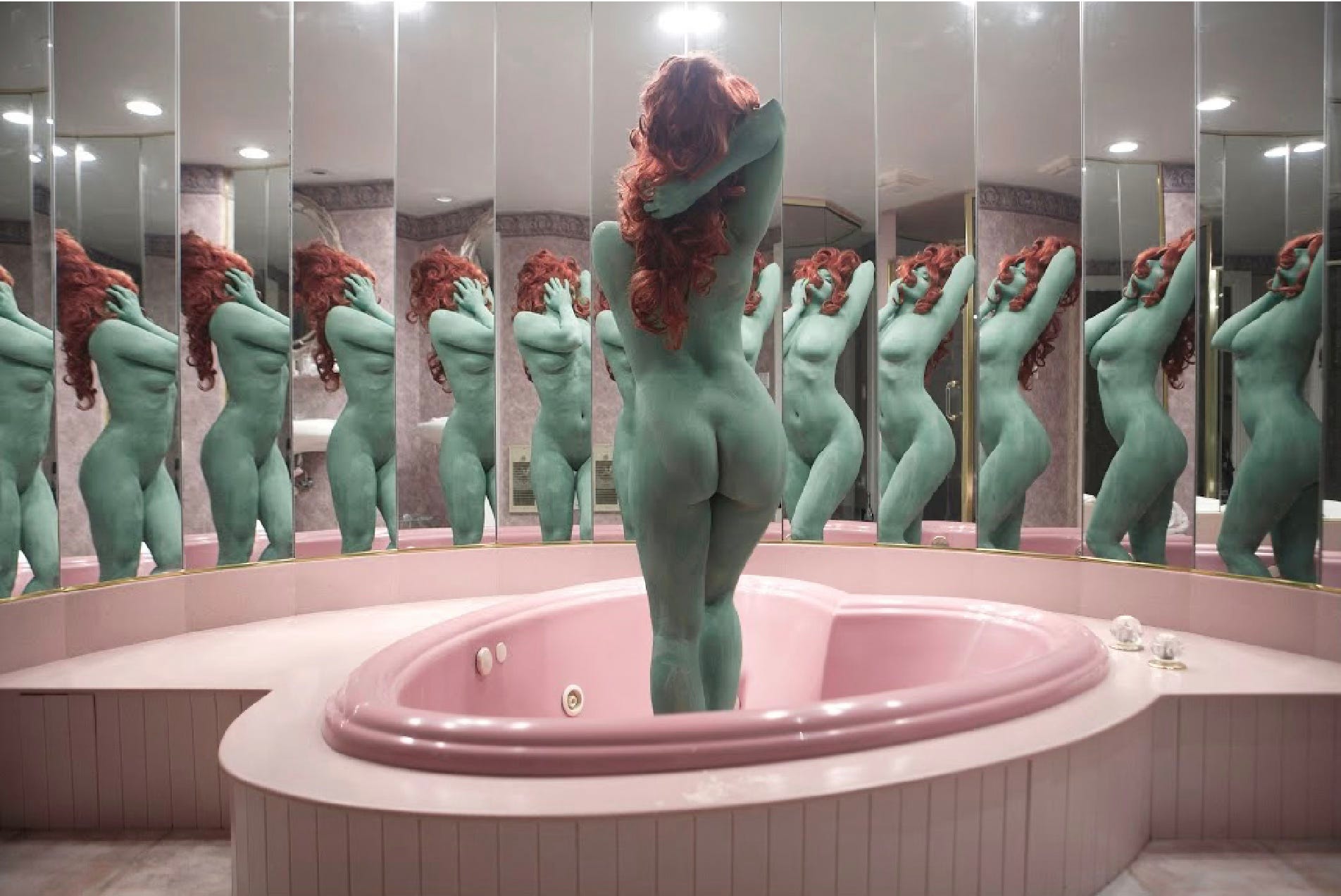
In cultures like mine, WEIRD ones, we may be more primed to usher in the new era of false gods. We already worship the false gods of productivity, politics, money, self, and fame, so what’s the problem with one more?
Traditionally religious cultures with strong communities may be more fortified to resist the temptation of viewing all-powerful technology through a religious lens because they already have religion. They know what it means to be humble in the face of something greater. They know what it means to resist temptation, fast, and take their conscience seriously. They believe they are answerable to something outside of themselves and their own ephemeral appetites.
In a nonreligious culture, we are pushed towards narcissism, the ultimate hollowing out of God to place ourselves at the center. The technology of AI will only further this agenda. However, much like the hedonistic and unfulfilling pleasures of things like fast food or pornography, false AI spirituality will starve people of their need for actual spirituality while tricking them into believing they are satisfying their deep need for it.
Apocalypse Now
We gravitate towards stories of end times. I am guilty of this – some of my favorite books and series illuminate the fallout of a post-civilizational world. Despite the material hardship (and zombies), there is something comforting about these settings. Within these stories of destruction, there also exists a cleansing of all that is false. In that, space is made for the truth of the human condition.
A huge solar flare could easily send the world into darkness, destroying electrical grids, and at least temporarily ending the internet. If that were to happen, it would be catastrophic because of how much our society has come to rely on it. However, something else would happen. We would have to contend with our existential reality in a way that most modern humans rarely have to do except on their deathbeds.
We are limited beings, we need one another, and death will happen to all of us. We often forget those things. Those of us in WEIRD cultures aren’t aware of all of the artificial systems that keep us fed and alive. And despite all of our material comforts, we long for truth. We long for the bare intensity of existence, a life where our where our relationships truly matter, and our actions are consequential.
In the superficial haze of internet videos, social media, and online culture, one day we will come to realize that it was all a massive collective hallucination. If it were all to end now, most of us would quickly forget the hold it had on us, or all the things we even saw on there. We would ask, was that a dream? Or did it really happen? I glimpse this whenever I do a digital fast. Once the cravings subside, I am left with total indifference.
One day we will have to contend with our lives, and not one of us will say we wished we had spent more time online, or that we’d had access to more technology. Every one of us will probably think, I wish I had loved more. As limited creatures, that is our one superpower, stretching throughout time and space, connecting back to our fragile and deteriorating bodies. No matter how much we smother the spiritual with the digital, one day all falsehoods will be cleared away, and only truth will remain.

The acronym WEIRD—Western, Educated, Industrialized, Rich and Democratic—aims to raise people’s consciousness about psychological differences and to emphasize that WEIRD people are but one unusual slice of humanity’s cultural diversity. WEIRD highlights the sampling bias present in studies conducted in cognitive science, behavioral economics, and psychology. Source
I wonder if that spike around the late 90s was due to a fear of Y2K.
If you believe prayers, visions, and dreams aren’t real, that betrays your own WEIRD-ness.
AKA robots
Simone, I carefully read and listened to your article. You articulately presented your thoughts on non-material or subjective ideas and concepts that humans have devised to explain the realities related to meaning-making and value determination. I particularly appreciated how you discussed digital technology and illustrated the correlation between the rise of atheists and non-religious people, and the decline of non-practicing and practicing religious people over the last 15 years—a period when smartphones became a part of everyday life. Your description of your brief periods of fasting from all digital technologies and your observations of their impacts provided a nice illustration of the pervasive influence of digital technology in our lives and its potential to supplant the roles of spirituality, relationships with others, and connection with nature. In your concluding section, you discuss how the haze of internet videos, social media, and online culture has become a 'collective hallucination'—a reality in its own right. You predict that one day all falsehood will be cleared, paving the way to a life where relationships truly matter, and all actions are consequential. It is a daring prediction, and I am not sure if it is in the context of a post-apocalyptic world or due to awakened humanity. All in all, I enjoyed reading your article and your elaborate exploration of these concepts.
Much to think about ❤️